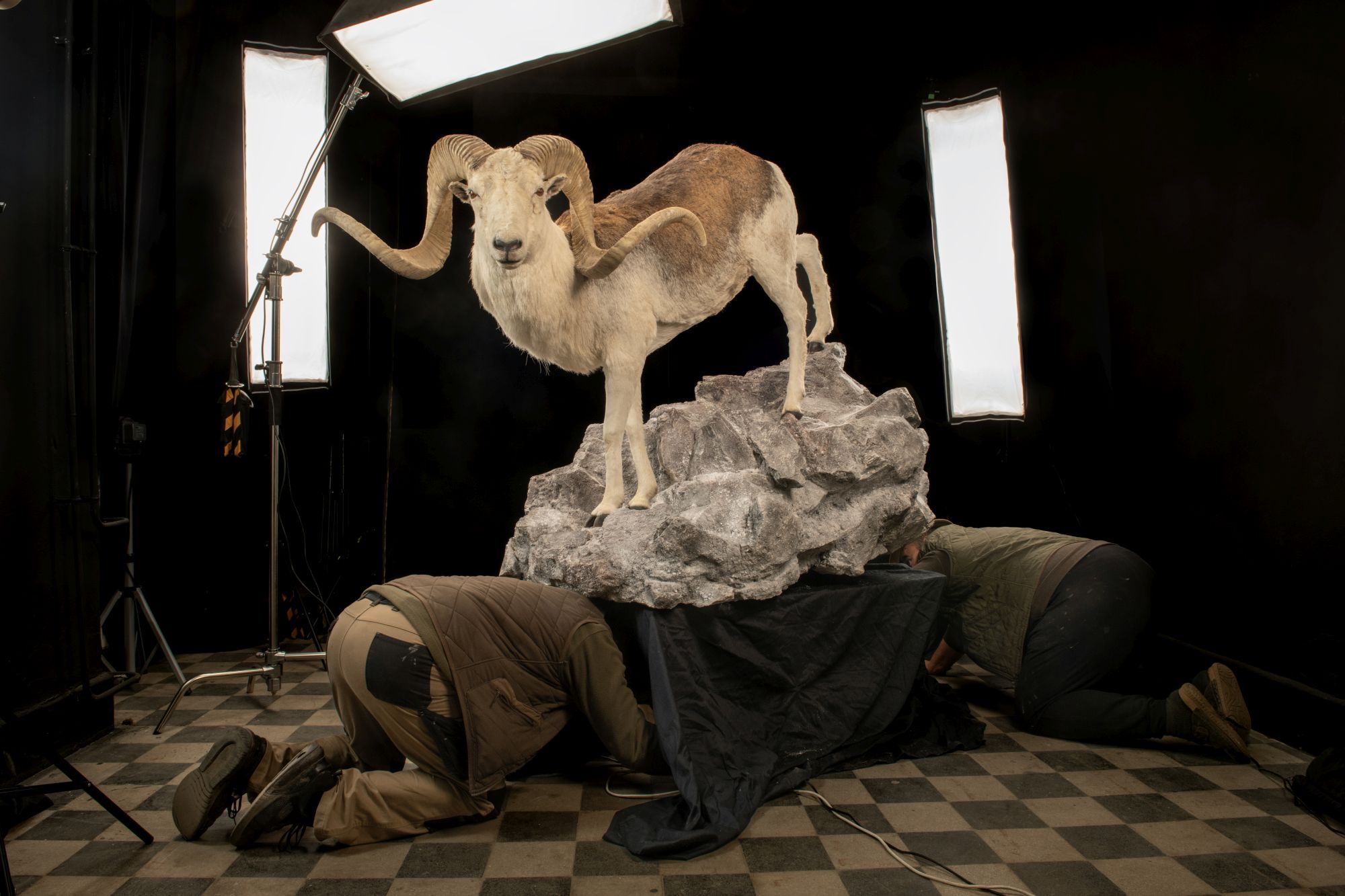
From the series A Memory of Nature’s Wildness
on-going project since 2022
digital capture; archival pigment print
Many people may wonder why it is worthwhile to preserve a dead animal through taxidermy, or why it matters to keep its memory alive. Taxidermy allows people to preserve and commemorate animals that were important to them. Thanks to the work of taxidermists, animals achieve a kind of afterlife, offering people an opportunity to come closer to nature and understand its diversity and values.
Urban life has almost completely pushed nature out of our surroundings: there are no wild animals or unknown dark forests around us, and even green spaces are scarce. Many people have contributed to this process over many centuries, and the end is slowly coming into sight. But if we invested so much effort in eliminating the wildness of nature, why do we still long to escape our cities and return to it, even if only along safe, signposted hiking trails? Why do we bring forest plants into our small flats in flowerpots? Why do we keep animals as pets whose ancestors not so long ago might have threatened our lives?
Our cities, built of reinforced concrete, resemble forests. Unlike nature, however, we keep them illuminated even at night, perhaps for fear of the instinctive creature that still lives in us.
Some people are enthusiastic about this new trend: fine art museums, private individuals, restaurants and tattoo studios are all willing to pay considerable sums. Taxidermy developed into an independent, new profession during the second half of the twentieth century. Today, meeting the increased demands requires a broad scientific education (including sufficient knowledge of zoology, animal taxonomy and anatomy), familiarity with the supporting industry, artistic sensibility, and, not least, a genuine love of animals besides the basic skills, abilities and manual dexterity. Taxidermists say their work causes no pain; rather, they give a new and higher form of life to the remains of animals that have already died.
60 × 40 cm / each
Ádám Urbán
(1976, Budapest)
Ádám Urbán is a Rudolf Balogh Award-winning photographer. He works in fashion, portrait, and commercial photography for various agencies. More recently, he has turned his attention to documentary photo series, while continuing his commercial work. He has received several awards, including prizes at the Hungarian Press Photo Competition, and has exhibited his work in solo shows and professional publications. He is a member of the Association of Hungarian Photographers as well as the art organisations RANDOM and Pictorial Collective. According to his ars poetica, he advocates simple and accessible, yet independently expressive and authentic content. To achieve this, he strives for originality rather than following established patterns, demonstrating a willingness to take creative risks. All of this together constitutes photography for him – this particular form of visual writing, which is synonymous with joy and diversity.